Posts Tagged ‘septoplasty’

How To Correct A Crooked Nose

Tuesday, November 6th, 2012

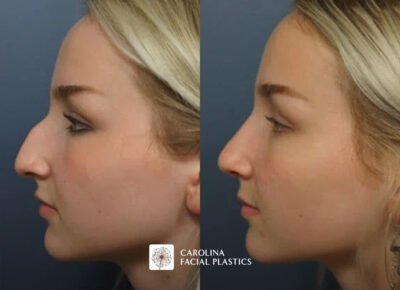
 How To Correct A Crooked NoseTo improve facial harmony, many times patients seek rhinoplasty surgery in Charlotte to straighten a crooked nose.  Absolute facial symmetry is not a goal of facial aesthetics as everyone has minor differences between the two sides of the face.  This is true when evaluating the facial features of supermodels, Tom Cruise, Brad Pitt, and Carmen Electra.  When people have obvious facial asymmetries, the eyes of onlookers are focused away from the eyes and smile to the obvious facial asymmetry.  One of the most common obvious facial asymmetries is a crooked nose.

A crooked nose will take attention away from a person’s beautiful smile or gorgeous eyes.  In evaluating a person with a crooked nose, it is important to understand the cause.  Common causes of a crooked nose are:

1)     Result of trauma:  History of a fight, car accident, or strike to the nose

2)     Congenital:  Patient born with a crooked nose

The nose is composed of bone and cartilage that is covered with skin, muscle, and fat.  The top part of the nose is the bony part, and the lower flexible part of the nose is the cartilage.  In evaluating a crooked nose, I first identify if the bone, cartilage, or both parts of the nose are crooked.  If the bone is crooked, osteotomies (breaking the nasal bones) must be done to straighten the nose.  If the cartilage is crooked, then other rhinoplasty techniques must be performed.  Typical procedures that may be performed to straighten the cartilaginous portion of the nose are:

1)     Septoplasty- Correcting a deviated septum

2)     Swinging door technique-  Correct a deviated septum at the entrance of the nose

3)     Spreader grafts-  Improve breathing, build of the nose, and straighten the nose

4)     Onlay grafts-  Re-build  a collapsed section of the nose to increase symmetry

5)     Columellar strut-  Help straighten a deviated tip

6)     Tongue and groove-  Powerful technique to straighten a deviated tip

As you can see, there are many techniques that I use to straighten a crooked or deviated nose for my patients in Charlotte.  I may have to use 1 or all of the above techniques to create a nose that is straighter and allow a patient to be able to easily breath for the rest of their lives.

Nasal Surgery to Improve Sleep

Wednesday, February 29th, 2012

There is no better feeling than waking up in the morning feeling refreshed after a good night’s sleep.  Some patients rarely achieve this feat and therefore feel tired and sleepy during the day.  There are many causes of daytime sleepiness, but today I want to focus on abnormal breathing during sleep.  This is referred to as obstructive sleep apnea or sleep disorder breathing, and there are nasal surgical options to improve it.

What is obstructive sleep apnea?

Obstructive sleep apnea or OSA occurs when there is blockage in the airway during sleep.  This blockage prevents normal breathing and triggers the body to react.  The body reacts in 4 ways:

1)  You stop breathing for few seconds (apnea)

2)  Your breathing slows down (hypopnea)

3)  Your mind wakes up (arousal)

4)  The oxygen content in your blood goes down

These reactions significantly decrease the quality of sleep, and can result in daytime sleepiness.

What can you do to improve breathing while asleep and feel more awake during the day?

There has been a vast amount of research and many books that solely pertain to this topic.  If a patient has OSA, the best treatment may be using a CPAP or BiPAP machine that helps you breath while you sleep.  Some patients cannot tolerate CPAP or have mild obstructive sleep apnea.  In these patients, septoplasty may be the best option for improvement.

What are the nasal surgeries to improve OSA?

The nose should be evaluated by a nasal specialist to identify the location of the blockage in the nose.  The most common areas of blockage in the nose are:

1)  Deviated septum

2)  Turbinate hypertrophy

The deviated septum is the cartilage and bone that separates the right and left nasal passageways.  If the septum is off center, part of it can be removed to open the airway.  This is called a septoplasty.  The surgeon must leave enough of the septum to support the nose and prevent it from collapsing.

Inside of the nose, there are 3-4 long cylinders of tissue that help control airflow, humidify the air, and clean inspired air (turbinates).  Sometimes one of these cylinders can become enlarged.  These cylinders can be made smaller to help improve a patient’s breathing.  This procedure is call a turbinate reduction.

straight septum and turbinates2 Nasal Surgery to Improve Sleep

deviated nasal septum2 Nasal Surgery to Improve Sleep

Can nasal surgery help me feel more rested?

Nasal surgery can significantly improve sleep quality and daytime sleepiness in patients with nasal breathing problems.  In regards to treating obstructive sleep apnea, these procedures may be beneficial for patients with mild cases.  It is unlikely that these procedures will significantly improve severe sleep apnea.  In patients that have to use high settings on the machine to help them sleep, these procedures may allow a patient to turn down the high settings.  A lower setting is typically more comfortable.

Why is this information important?

The nose is a complex anatomical structure.  Many structures interact to provide the proper passageway that may enable a patient to breathe normally.  Disruption of breathing can greatly affect a patient’s quality of life by making them feel tired and sleepy, but luckily, the opposite is also true.  If a patient has structural components making breathing difficult, this can be fixed with surgery, which may greatly enhance their life.  Patients seeking breathing improvement or aesthetic improvement of the nose should see a nasal specialist that understands both aspects of the nose.

I Think I May Have Broken my Nose, What Should I Do?

Sunday, February 12th, 2012

The nose is the most commonly broken bone of the face.  In the case that you or someone you know breaks their nose, it is important to know how to treat the injury.  Immediately after the injury, it is most important to ensure that the patient has not developed a more serious injury. If the patient has lost consciousness, is acting unusual, or has any other concerns, someone should call 9-1-1 immediately.

Many times after breaking the nose, it will begin to bleed.  In this instance, pressure should be applied to the soft part of the nose towards the tip as one leans their body forward. It is very important for blood to come out of the nose as one leans forward as opposed to leaning backwards and having blood go down the throat. If blood goes down the throat it can cause difficulty breathing or nausea. I recommend keeping pressure on the nose for at least 20 minutes to stop the nose bleed.

An ENT, also known as a head and neck surgeon, or a facial plastic surgeon are the most knowledgeable doctors to treat a broken nose. During an initial evaluation of a broken nose, a full medical history is taken and an understanding of all surrounding events leading up to the broken nose are important.  During the examination, the entire face is examined to ensure that there are not any other injuries.  The nasal septum is examined in order to ensure that the it did not fracture or a collection of blood did not form in the septum, a condition known as septal hematoma.   A septal hematoma needs to be treated immediately.  The pressure from the hematoma can cause the cartilage in the nose to weaken or die, resulting in severe nasal collapse.

The nasal bones connect to the base of the skull.  Sometimes during a severe nasal fracture, it can cause a break at the skull resulting in leaking of the fluid around the brain into the nose and down the throat, a CSF leak. This results in constant nasal dripping or a salty taste in the mouth.  This is easily treated if diagnosed promptly and correctly.

After correctly diagnosing the broken nose, there are many treatment options.  If the broken nose has not caused a significant change in the appearance of the nose, I recommend ice packs, keeping the head elevated, and nasal sprays.  If there appears to be a change in the appearance in the nose, then a procedure may be recommended.  If the patient is seen within 2-3 hours of the nasal fracture, before the start of nasal swelling, the nasal bones can be “popped” back into position.  This can be done in the office, but it can be painful.  Patients that require their bones popped back into place, closed reduction of a nasal fracture, can be placed under twilight anesthesia in the outpatient surgery center.  If the patient is evaluated after the formation of nasal swelling, the patient will have to wait 3-10 days before preforming a closed reduction of the nasal fracture.  The swelling camoflauges the appearance of the nose and therefore the surgeon cannot accurately correctly the nasal deformity.  The bones remain loose enough to be able to be moved back into place for up to 10 days.  If the septum has been fractured as well, then it may also be moved back into place during the closed reduction of the nasal fracture.  There are many additional procedures that may need to be preformed to get the nose back into position, including but not limited to rebreaking the nasal bones (nasal osteotomies), septoplasty, spreader grafts, onlay grafts, or even a rhinoplasty.

Patients that have broken their nose years before are treated differently than a patient who recently broke their nose. They normally have aesthetic or functional concerns, such as nasal breathing.  Depending on their anatomy, they may need their septum removed, a procedure known as septoplasty, or may require a rhinoplasty, which is a nose job.


Carolina Facial Plastics has offices in Southpark, North Carolina and Irmo, South Carolina serving patients in the surrouding areas including Dillworth, Meyers Park, Ballentyne, Lake Norman, Huntersville, Moorseville, Columbia, Lexington, and Lake Murray.


The Doctor as the Patient: My Septoplasty for Nasal Airwary Obstruction Procedure

Friday, February 10th, 2012

You know how they say doctors never take care of themselves?  Well…. I am guilty as charged.  Although I exercise almost everyday, recently ran a half marathon with my fiancee, eat well, and try to get plenty of rest, I have never been able to breathe out of my nose properly, which I have ignored for quite some time. Eventually, I started to convince myself that there was a slowly growing tumor in my nose.  Physicians are also slight hypochondriacs, of which I am obviously also guilty, due to the fact that I started to truly believe I had a tumor in my nose.  A tumor would have been an extremely rare cause of nasal obstruction, but it is the most serious type.  I happened to be in the CT scanner room one day at my office, and I thought it would be good time to identify the cause of my deviated septum.

Dr. Jonathan Kulbersh’s CT scan:

ctblogpic 1024x577 The Doctor as the Patient: My Septoplasty for Nasal Airwary Obstruction Procedure

Deviated Septum Causing Complete Nasal Obstuction (Dr. Kulbersh's Poor Nose))

On a CT scan, the left and right side are switched.  The green diamonds represent the eyes and the yellow diamond is over the brain.  The blue arrow shows the open nasal passageway on the left side and the red arrow shows the deviated septum causing complete nasal obstruction (on CT scans black is air, grey is tissue, and white is bone).

A CT scan is an unnecessary test to diagnose a deviated septum.  A deviated septum is easily diagnosed by a qualified facial plastic surgeon.  I was relieved to know my deviated septum was the cause of my nasal airway blockage, and it was not blocked by a tumor. I was also relived to find out that my breathing could be fixed from a safe surgical procedure, septoplasty.  My first step to fix my deviated septum was to find a qualified cosmetic surgeon, Dr. Babak Azizzadeh. Even though I am a facial plastic surgeon specialist myself, I still had a consultation with my doctor.  We went over the risks, benefits, alternatives, and location of the septoplasty.  After gaining complete trust from a great first consultation with Dr. Babak Azizzadeh, I moved forward with the septoplasty surgery.

The septoplasty surgery was yesterday, and was my first time being on the “other side of the table”.  Even though I am a facial plastic and reconstructive surgeon and have done this procedure many times, I was still nervous before the surgery.  When I showed up at the outpatient surgery center, I was greeted with a very warm welcome, which eased my anxiety. I was taken into the bathroom, where I changed into a gown, socks, and put on a hat.  I was then placed in a patient room and welcomed by a very friendly nurse.  She asked me a variety of medical questions, and then placed an IV into my arm.  Unfortunately the first IV was not placed in the vein properly, and the anesthesiologist had to administer the IV in my other arm.  When the anesthesiologist placed the IV, he first numbed the area with lidocaine and this technique was much more comfortable.  After the painful experience with the first IV, I will now insist that all my patients receive lidocaine before their IV’s.  After the placement of the IV, my doctor came into the room to answer any of my last minute questions and concerns.  The anesthesiologist then gave me a medication, Versed, to relax my nerves, and I was taken into the operating room.  All I can remember is the anesthesiologist placing oxygen on my face, and then the surgery was over.  (I was told later that I was feisty waking up from surgery!)

Immediately after waking up, I could feel slight pain in my nose.  I told the nurse about the pain, and she immediately gave my an IV pain medication that resolved the pain. Within one hour, I was feeling better and ready to go home.

post op The Doctor as the Patient: My Septoplasty for Nasal Airwary Obstruction Procedure

Dr. Jonathan Kulbersh with Nasal Bandage in Place

I am always honest with my patients, and I would say last night was uncomfortable.  I was not in pain, but I could not breath out of my nose because I have silicone nasal splints in my nose.  Therefore, I was breathing through my mouth, which became very unpleasant.  My nose slowly dripped small amounts of blood throughout the entire night.  If it says anything about the experience, I am writing a blog post about it the next morning!

Being the patient for a facial cosmetic plastic surgery procedure was a valuable experience.  As physicians, we are striving to understand our patient’s needs and concerns.  There were many little events yesterday that created a trusting environment that improved my surgical experience. The quality of the nurses, the doctor’s extra few minutes he took to answer my questions and the staff’s initial warm welcome got the day off to the right start.  For me, most importantly, I also now know the importance of the doctor spending a few moments with the patient before surgery for reassurance.  Additionally, my cosmetic surgeon called me the evening after the surgery to ensure I was doing well.  I learned many valuable lessons over my surgical experience that I hope to use to improve the experience for my patients in the Carolinas.

I am a facial plastic and reconstructive surgeon that trained in Beverly Hills.  I have two offices in the Carolinas, Charlotte and Columbia, serving the Dillworth, Ballentyne, Southpark, Meyers Park, Eastover, Lake Norman, Huntersville, Irmo, and Lexington.

My Friend Said She Had a Deviated Septum Repaired – Does That Mean She Had a Rhinoplasty/Nose Job?

Monday, February 6th, 2012

Everyone has a friend who has had their deviated septum repaired.  Many times, people assume this means their friend had a nose job, also known as rhinoplasty, or used their deviated septum as an excuse to have a nose job, but this is not true.  The septum is composed of both cartilage and bone and separates the right and left nasal passageways.   If the septum is straight, then the air can freely flow through the nose.  If the septum is off to the side, which is a deviated septum, then the passageway can be narrowed, which causes nasal obstruction.  There are many causes of nasal obstruction with a deviated septum being one of the most common causes.  It is important to see a rhinoplasty or nose specialist in the Charlotte or Columbia area to ensure the correct diagnosis and treatment of nasal obstruction.

If the deviated septum is identified as the cause of the nasal blockage, then a short, minimally-invasive procedure, septoplasty, can be performed as an outpatient surgery.  During the procedure, all of the incisions are hidden in the nose and the majority of patients will not require any packing in the nose.  The recovery time is only a few days and patients are then back to their normal routine.  Their breathing will improve over a few weeks after the swelling inside the nose resolves.

Many times patients undergoing a nose job will have a septoplasty simultaneously to improve their breathing or to collect the cartilage to be used during the rhinoplasty, which is used to help support the nose.  Patients can undergo a septoplasty to repair a deviated septum in order to improve their breathing without having a nose job or patients can have a nose job without having their septum repaired.  So, next time your friend says they had their deviated septum repaired, do not assume that they had a rhinoplasty.

Dr. Jonathan Kulbersh is a Board-Certified Head and Neck Surgeon and is fellowship trained in facial plastic and reconstructive surgery.  His practice, Carolina Facial Plastic Surgery, sees patients in his offices in Charlotte, North Carolina and Columbia, South Carolina serving the Southpark, Meyers Park, Eastover, Ballentyne, Huntersville, Irmo and Lexington areas.