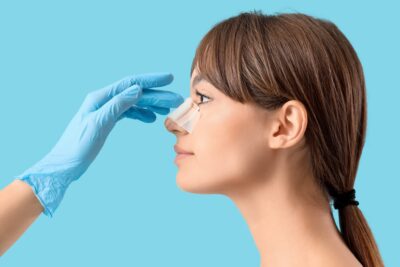
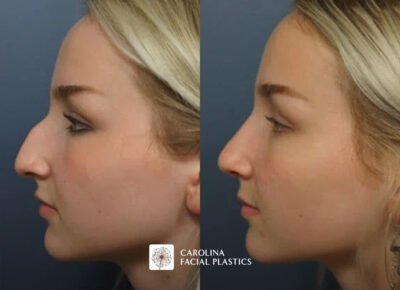
There are two steps that must occur for a successful aesthetic outcome in patients with thin skin after a rhinoplasty in Charlotte. The nose is supported by an underlying framework composed of bone and cartilage. During rhinoplasty, this framework is changed and then the skin over the nose has to heal back onto the framework. It shrinks and wraps itself on the foundation over one year. During this time, the nose becomes more defined and elegant.

The cartilage and bony foundation of the nose. The skin will eventually shrink wrap back onto the foundation.
The thickness of the skin plays a key role in the ultimate outcome. Thick skin will not shrink and wrap as well. This will limit the definition possible in the nose. On the other end of the spectrum, in patients with very thin, it skin shrinks and wraps on the framework very well. This creates a risk that a minor irregularity under the skin may become noticeable over time. To prevent an issue that will sometimes appear months to years after the surgery, I will use a thin sheet of natural tissue from the body called temporalis fascia, to lie underneath the thin skin of the nose. This will slightly thicken the skin and help prevent the appearance of a minor irregularity.
Temporalis fascia is tissue that overlies the temporalis muscle located in the temple region. The incision to get the fascia is very small and is placed in the hair to hide it.

Tissue that covers the temporalis muscle is harvested to be placed in the nose, slightly thickening the skin.
As a rhinoplasty specialist in Charlotte, I will take every step possible to ensure that my patients have the best chance to create a nose that will last a lifetime.